The Good, The Bad And The Ugly: Inside Swamp’s New Farm Bill

House lawmakers advanced a farm bill in March that would spend more than $1 trillion over a decade without putting a dent in the U.S.’ massive spending deluge.
The legislation seeks to leave in place SNAP policy changes first implemented in the One Big Beautiful Bill (OBBB) in July 2025, while expanding federal control over pesticide labeling and directs additional funding to broadband, climate and conservation initiatives. The bill also includes a provision affecting ranchers, setting up a possible showdown between rival factions of GOP lawmakers.
‘Glass Half Full’
Compared to the previous Farm Bill passed in 2018, which was projected to cost roughly $867 billion over a decade, spending has remained relatively unchanged, shifting funds instead of making noticeable cuts.
“No big increase, but no real cuts,” Bryan Riley, director of the free trade initiative at the National Taxpayers Union, told the Daily Caller News Foundation, describing the bill as a “glass half full” approach, avoiding major spending hikes but falling short of meaningful reductions.
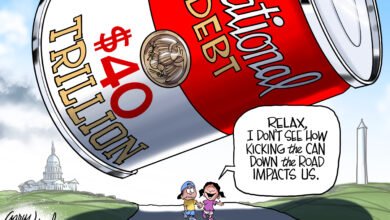
The bill would have no effect on direct spending over the 2026-2036 period, according to the Congressional Budget Office (CBO), meaning it reallocates funds within the farm bill which is projected to exceed $1 trillion over the next decade. The U.S. faces a growing debt burden expected to hit $40 trillion by November.
The CBO’s findings come as lawmakers continue to preside over the massive national debt, with mandatory spending programs like Social Security, Medicare and Medicaid driving a large share of federal spending. Despite warnings, Congress failed to enact significant deficit reduction, as public approval for Congress hit 16% in March, according to Gallup.
Federal Overreach?
The Farm bill could also face additional resistance from lawmakers over a provision tied to the Food Security and Farm Protection Act (S. 1326), which would limit states’ ability to propose agricultural standards on products originating from out-of-state producers. Supporters of the provision, including lawmakers such as Republican Iowa Sen. Joni Ernst, argued that the measure would protect farmers and ranchers from the burdensome and conflicting state regulations. Ernst was a co-sponsor of the bill in 2023, which formerly was known as the Ending Agricultural Trade Suppression (EATS) Act.
According to sources with knowledge of the bill, Republican Florida Rep. Anna Paulina Luna, Republican South Carolina Rep. Nancy Mace and Republican New York Rep. Andrew Garbarino are expected to push to have the language removed as the bill moves forward.
“As liberal activists who have never set foot on a farm try to ban our bacon with dangerous and arbitrary overregulation, I’m fighting to make sure the voices of the farmers and experts who know best are heard,” Ernst said in a statement to the DCNF. “After the U.S. Supreme Court left an open invitation for Congress to strike down Proposition 12, it’s time we band together to end California’s war on breakfast and other nonsensical standards that threaten our national security, jeopardize the livelihoods of our farmers, and hike up prices at the grocery store.” Ernst added.
The measure has drawn support from industry stakeholders, including the largest pork manufacturer in the U.S., Smithfield Foods, a Chinese-owned company.
However, the provision has also drawn opposition from ranchers and advocacy groups who argued that the measure could override state-level standards, negatively affecting local producers who rely on these distinctions and potentially leading to the closure of locally owned farms and ranches.
“This would override state-level standards and make it harder for producers who have invested in meeting those requirements to compete,” Marty Irby, president and CEO of Capitol South, a firm that represents ranchers opposing the provision, told the DCNF.
“It would be a one-size-fits all policy,” Irby said.
Irby noted the provision could have a major impact on the pork market, adding “you’ll see a ton of pork producers go out of business.”
Farming And MAHA
America’s agricultural sector faces pressure due to the war with Iran, which has disrupted fertilizer supply and contributed to higher consumer prices seen at the supermarket. Food costs are predicted to increase 3.6% according to the Department of Agriculture (USDA).
“A lot of problems farmers are facing are tied to trade,” Riley told the DCNF, citing tariffs and export challenges along with broader Middle East tensions.
The bill also includes a provision requiring national uniformity in pesticide labeling, limiting a state’s ability to impose additional warning requirements beyond those approved by the Environmental Protection Agency (EPA).
Federal law currently limits a state’s ability to impose its own labeling on products, but this provision would go one step further, restricting potential liability lawsuits against the pesticide companies.
“If consumers are not warned about the potential harm associated with their use of pesticide products, they do not have the ability to make a smart decision on product choice,” Jay Feldman, executive director of the nonprofit group Beyond Pesticides, told the DCNF.
The provision is part of a broader debate over the regulations of pesticide use. Groups such as the nonprofit Beyond Pesticides argue that the language could shield companies from “failure to warn” litigation by cutting down the ability to require additional warnings beyond federally approved labels.
The issue has drawn scrutiny from the Make America Healthy Again (MAHA) movement, as Health and Human Services Secretary Robert F. Kennedy has argued that manufacturers should be held accountable for failing to warn consumers about potential health issues.
The legislation also redirects funding toward new projects, including an additional $350 million to the Reconnect broadband program, which received $2 billion under former President Joe Biden’s Infrastructure Investment and Jobs Act, sparking questions about potential overlap as multiple programs have been tasked with expanding broadband access in rural areas.
“There are far too many overlapping federal programs funding broadband deployment, making duplication and waste of taxpayer dollars inevitable,” Randolph May, president of the Free State Foundation, told the DCNF. “At a minimum, the ReConnect program funding should be suspended until existing broadband funds are fully disbursed.”
The USDA failed to set clear performance goals for broadband initiatives and identified gaps in oversight to address fraud risks, according to a 2022 Government Accountability Office (GAO) review that examined programs, including ReConnect.
In 2020, House Republicans called for an audit of the USDA Broadband Program, citing potential overlap within the program.
The bill also seeks to raise conservation funding, including initiatives tied to environmental and climate-focused agricultural practices, issues that have been a key priority for Democrats for years. These programs fund efforts like soil conservation, water management and emission reduction programs, raising questions about spending priorities as the bill fails to reduce federal spending.
“Throughout this markup, it became clearer than ever before that our country needs a new farm bill, and we don’t need it next year, or next Congress. We need it now. I look forward to working in good faith with my colleagues on both sides of the aisle as we move toward a final vote on the House floor,” House Agriculture Committee Chairman Glenn Thompson said in a statement released in March.
The bill would strengthen the safety net for many farmers by expanding crop insurance and loan programs and providing disaster assistance, while also stabilizing rural health systems by expanding access to care, according to the statement.
The legislation passed the committee in March and now heads to the House floor, as the current spending bill is set to expire in September. While farm bills have historically been bipartisan-supported pieces of legislation, this measure faces uncertainty as Democrats seek to reimplement SNAP benefits cut in the OBBB. The House Rules Committee is expected to take up the bill as it moves to the floor for a vote, according to a notice released by the House Rules Committee on Thursday.
“This may not be the end of story,” said Riley, suggesting Congress may have to revisit additional spending in the future.
Content created by The Daily Caller News Foundation is available without charge to any eligible news publisher that can provide a large audience. For licensing opportunities of our original content, please contact licensing@dailycallernewsfoundation.org