WASHINGTON — The Supreme Court has a lot of problems with the Trump administration’s theory for restricting birthright citizenship.
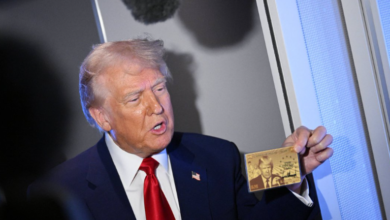
President Donald Trump, who became the first chief executive to attend Supreme Court oral arguments on Wednesday, faced legal challenges soon after signing his day-one executive order ending guaranteed citizenship for children of illegal aliens or migrants on temporary visas.
From the first row of the public seating section, Trump had a direct view of the justices as they contended with his solicitor general, John Sauer, on the original meaning of the 14th Amendment’s Citizenship Clause. The clause, which guaranteed citizenship for the children of slaves, states that all people born in the United States and “subject to the jurisdiction thereof” are citizens.
“It’s a new world,” Chief Justice John Roberts told Sauer. “It is the same Constitution.”
Policy considerations like how birthright citizenship gave way to Chinese birth tourism businesses and incentivized an illegal immigration crisis fell flat before the justices, who wanted to know where the administration got its theory that parents must be “domiciled” for children to be citizens. The government argues that temporary visitors and illegal aliens cannot be “subject to the jurisdiction” of the United States because they lack ties of allegiance.
“You’ve mentioned several times the practices of other countries, and that obviously, as a policy matter, supports what you are arguing here, ” Justice Brett Kavanaugh told Sauer. “But obviously we try to interpret American law with American precedent based on American history…Why should we be thinking about…gee, European countries don’t have this?”
This is the second time Trump’s executive order has come before the justices, though they were not asked to decide its merits before. When the administration appealed the district court judges’ decision to halt the order last term, it only asked the justices to weigh in on the question of “universal injunctions,” which the majority ultimately held in United States v. CASA likely exceeded the authority granted to federal courts.
Since the Supreme Court struck down Trump’s tariffs in February, the president has not been shy about voicing his disappointment. He said his two appointees who sided with the majority “sicken” him and warned Monday ahead of the birthright citizenship case that “Dumb Judges and Justices will not a great Country make.”
Trump quietly left the courtroom an hour and twenty minutes after arguments began, shortly after Sauer finished presenting the government’s side of the case. Some administration officials like Commerce Secretary Howard Lutnick and Attorney General Pam Bondi joined him to listen to arguments.
New World Meets Old Law
“Now, normally you would think that a person who is subject to arrest anytime and removal could not establish domicile,” Justice Samuel Alito said to Sauer.
“But we have an unusual situation here because our immigration laws have been ineffectively and in some instances unenthusiastically enforced by federal officials,” Alito said. “So, there are people who are subject to removal at any time…but they have, in their minds, made a permanent home here. That raises a humanitarian problem.”
Justice Elena Kagan said the government’s position is a “revisionist” history. Their position relies on “obscure” sources and a text that “does not support” their position on its face, she said.
Chief Justice John Roberts likewise said the government cites “quirky” examples that support its position, prior exceptions to birthright citizenship like children of ambassadors and enemies during a hostile invasion.
The principle of birthright citizenship, or “jus soli,” has its roots in English common law. Defenders say the Supreme Court built on this history in its 1898 United States v. Wong Kim Ark decision, which found children “born of resident aliens” are U.S. citizens, while the administration says it’s clear the 14th Amendment’s framers did not intend to continue in the old tradition.
Won Kim Ark’s parents, Sauer noted, were domiciled residents, though they could not become naturalized citizens due to the Chinese Exclusion Act.
“I’m not sure how much you want to rely on Wong Kim Ark,” Gorsuch told Sauer. Others agreed the case does not seem to help the administration’s position.
Yet the justices picked up on Sauer’s point during questioning of ACLU National Legal Director Cecillia Wang, asking what to do about the frequent appearance of the word “domicile.”
“Isn’t it at least something to be concerned about, to say that it’s discussed 20 different times and has that significant role in the opinion?” Roberts asked.
“You can’t make sense of the holding in the case without looking to the controlling rule of decision, which is the common law,” Wang said. “Under English common law, domicile was not relevant.”
Alito suggested the phrase “not subject to any foreign power,” which Congress used in the Civil Rights Act of 1866, might be more “straightforward.” A child born to an Iranian father who entered the United States illegally would still have a duty to provide military service to the Iranian government, Alito noted.
Near the end, Kavanaugh offered up what could be an easy way out for the justices.
“If we agree with you on how to read Won Kim Ark, then you win,” Kavanaugh said to Wang. “So if we did agree with you…that could be just a short opinion, right?”
Content created by The Daily Caller News Foundation is available without charge to any eligible news publisher that can provide a large audience. For licensing opportunities of our original content, please contact licensing@dailycallernewsfoundation.org