Medal of Honor Monday: Army Sgt. Alvin York
Army Sgt. Alvin C. York, an infantryman, received the Medal of Honor for valor due to his heroic actions during a World War I operation in France, actions that would be immortalized in the 1941 film “Sergeant York.”
York was born Dec. 13, 1887, in Pall Mall, Tennessee. His father, William Uriah York, was a blacksmith, hunter and farmer on their 75-acre plot. His mother, Mary Elizabeth York, was a busy housewife, tending to their 11 children. York had minimal schooling. He helped with the farm and became a sharpshooter, skills honed from years of hunting.
In November 1917, York was drafted into the Army, despite claiming conscientious objector status. He went to basic military training at Camp Gordon, Georgia, with Company G, 2nd Battalion, 328th Infantry Regiment, 82nd Infantry Division, the unit he would remain with throughout the war.
In June 1918, he arrived in France. In September, his regiment participated in the Battle of Saint-Mihiel and later engaged in the Meuse-Argonne Offensive, the largest World War I American operation.
During this offensive and on the date of his valor, Oct. 8, 1918, York, a corporal at the time, and his unit were tasked with capturing a railroad. The platoon got lost in the forest behind enemy lines and soon were met with machine-gun fire.
Nine members were killed, including all of the noncommissioned officers, leading York to assume command of the platoon. Fearlessly leading the remaining seven men, he charged toward a machine-gun nest which was pouring incessant fire at his platoon.
At the time, York was carrying a rifle and a pistol. During his heroic ordeal, he used his hunting skills to silence the machine-gun nest, killing 25 Germans and leading to the enemy commander surrendering. All in all, his unit took 132 prisoners.
York was promoted to sergeant Nov. 10, 1918, just a day before the end of the war, honored today as Veterans Day. The Medal of Honor was presented to him the following April in France, by Army Maj. Gen. George B. Duncan, 82nd Infantry Division commander.
On May 22, 1919, he arrived back in the U.S., to a hero’s welcome, aboard the cargo ship SS Ohioan and was discharged from the Army a week later.
The next month, he married his childhood sweetheart, Gracie Loretta Williams. They had eight children, with three of his sons going on to serve in the military.
Following the war, local nonprofit and other civic organizations raised enough money to build York a large, two-story home and to purchase 400 acres of land for him along the Wolf River in Pall Mall.
York committed the rest of his life to philanthropic causes, establishing a Bible school in his hometown, founding the Alvin C. York Foundation to increase economic and education opportunities in eastern Tennessee and founding the Alvin C. York Agricultural Institute in Jamestown, Tennessee.
During World War II, York tried to reenlist and serve in combat. However, he had health issues that prevented his request. Instead, he served stateside as an Army major, in the Army Signal Corps giving motivational speeches to troops, teaching marksmanship and promoting war bonds.
York died Sept. 2, 1964, and was buried at Wolf River Cemetery in Pall Mall. His wife died Sept. 27, 1984, and was buried beside him.
York’s grandson, retired Army Col. Gerald E. York, was in the Army for 31 years, serving in combat during the Vietnam War. He continues to work to preserve his grandfather’s legacy, running the Sergeant York Patriotic Foundation, which supports education opportunities in eastern Tennessee.
His Medal of Honor is on display at the Tennessee State Museum in Nashville.
The site of his birthplace log cabin and his postwar farmhouse are preserved as part of the Sgt. Alvin C. York State Historic Park in Pall Mall.
The film “Sergeant York” is loosely based on his upbringing and wartime experience. Gary Cooper, the lead actor, won an Academy Award for his realistic portrayal of York.
A bronze statue of him is on the grounds of the Tennessee State Capitol in Nashville. The Alvin C. York Institute that he founded is now a high school. The Alvin C. York Hospital in Murfreesboro, Tennessee, and the Alvin C. York Bridge that spans the Tennessee River are named for him, as well as York Avenue in New York City.
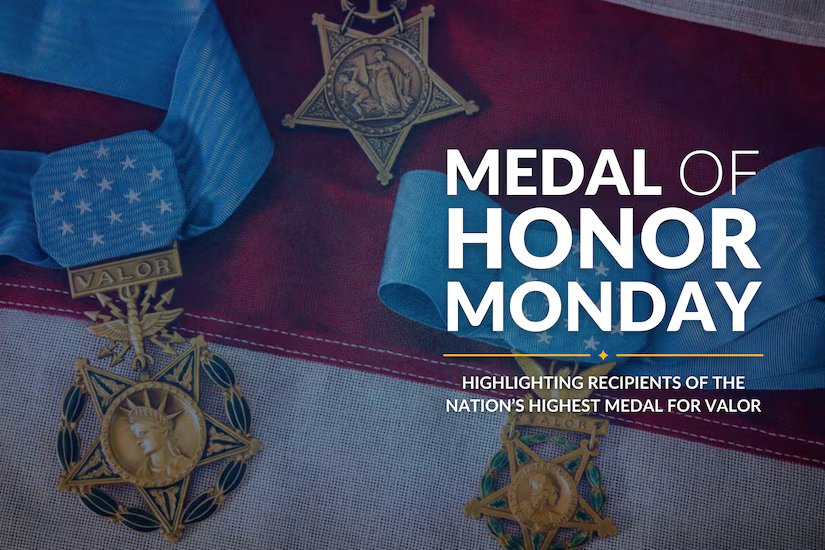
This article is part of a weekly series called “Medal of Honor Monday,” in which we highlight one of the more than 3,500 Medal of Honor recipients who have received the U.S. military’s highest medal for valor.
Source: Department of Defense
Content created by Conservative Daily News is available for re-publication without charge under the Creative Commons license. Visit our syndication page for details.