‘Delete From The Deleted File’: Fauci Tried To Destroy Gain-Of-Function Research Email, New Docs Reveal

Eight years before COVID emerged, a journalist issued a prophetic warning that risky viral research could usher in “doomsday” and damage the reputation of the National Institutes of Health (NIH). Anthony Fauci groused in an email to an aide about that warning, then instructed the aide to permanently delete the exchange, documents obtained by the Daily Caller News Foundation show.
The documents add to growing evidence that Fauci destroyed public records despite his sworn testimony that he never did. Deleting government records violates federal law.
Fauci did not respond to a request for comment.
In 2011, the advent of gain-of-function research — experiments that make viruses more infectious or deadly in the lab — caused its first major controversy. With funding from Fauci’s institute at the NIH, Dutch virologist Ron Fouchier had made an airborne strain of a bird flu with an estimated 50% fatality rate, which he described as “probably one of the most dangerous viruses you can make.”
Fauci and New York Times science writer Phil Boffey traded barbs in newspaper opinion pages about the work.
Manmade pandemic viruses are a “risk worth taking,” Fauci insisted in a December 2011 Washington Post editorial, because they could help drugmakers and public health get a jump start if they emerge in nature. NIH Director Francis Collins and National Institute of Allergy and Infectious Diseases Vaccine Research Center Gary Nabel co-authored the op-ed.
The New York Times published an op-ed apparently written by Boffey in January 2012 arguing that NIH created an “engineered doomsday” that could kill “hundreds of millions of people.” The new emails reveal the author of the un-bylined op-ed for the first time.
“The consequences, should the virus escape, are too devastating to risk,” he said in an apparent reference to the title of Fauci’s op-ed.
Boffey wrote a follow-up in March 2012 titled “The Truth About the Doomsday Virus?” Under scrutiny from the press, Fouchier had backpedaled on his earlier statements about his virus’s lethality. Fauci meanwhile pushed to publish the Fouchier experiment despite biosecurity experts’ concerns the information could fall into the hands of a bioterrorist.
As the question marks suggests, Boffey was skeptical of Fouchier’s assurances. Experts who had read his initial description of the experiment said it stated the airborne virus remained as lethal as the natural one, he wrote.
One sentence really rattled Fauci: “Now, this country’s National Institutes of Health, which financed the research and has its own reputation on the line, is asking the [NSABB] to reconsider its call to redact details before publication.”
“Phil Boffey is really off base here,” Fauci wrote to Collins, on March 4, 2012. “He is acting like a mischievous guy.”
“Clearly, people are getting to Phil Boffey and he is swallowing it,” Fauci sounded off in a more candid email to a subordinate the next morning.
Fauci strongly opposed a recommendation from the NIH’s biosecurity advisors to not publish sensitive details about Fouchier’s experiment. He said that if the advisors did not change their recommendation “the field of research on influenza … has a serious problem.”
“Please delete this e-mail and then delete from the deleted file,” Fauci said on his NIH email in apparent violation of federal record-keeping laws.
Kentucky Republican Sen. Rand Paul highlighted two other instances of Fauci apparently seeking to delete public records in 2020, despite his sworn testimony before another committee in 2024 that he never did.
Fauci ultimately persuaded NIH’s biosecurity advisors to allow the Fouchier experiment to be published in full.
Boffey and Fouchier did not respond to a request for comment.
Fouchier And COVID’s Origins
When the COVID-19 pandemic emerged, Fouchier worked with Fauci and other virologists to downplay the possibility of a lab origin. Fouchier ghostwrote a key argument in “The proximal origin of SARS-CoV-2,” a paper dismissing a possible lab origin of COVID. Fauci would frequently cite the paper and its authors over the years without revealing he collaborated with them behind-the-scenes.
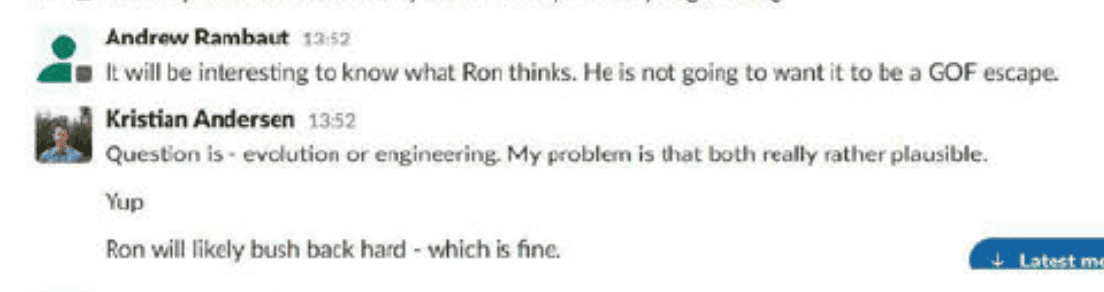
Yet privately the paper’s authors described Fouchier as “unbelievably conflicted.”
“Ron … is not going to want it to be a GOF [gain-of-function] escape,” one author said.
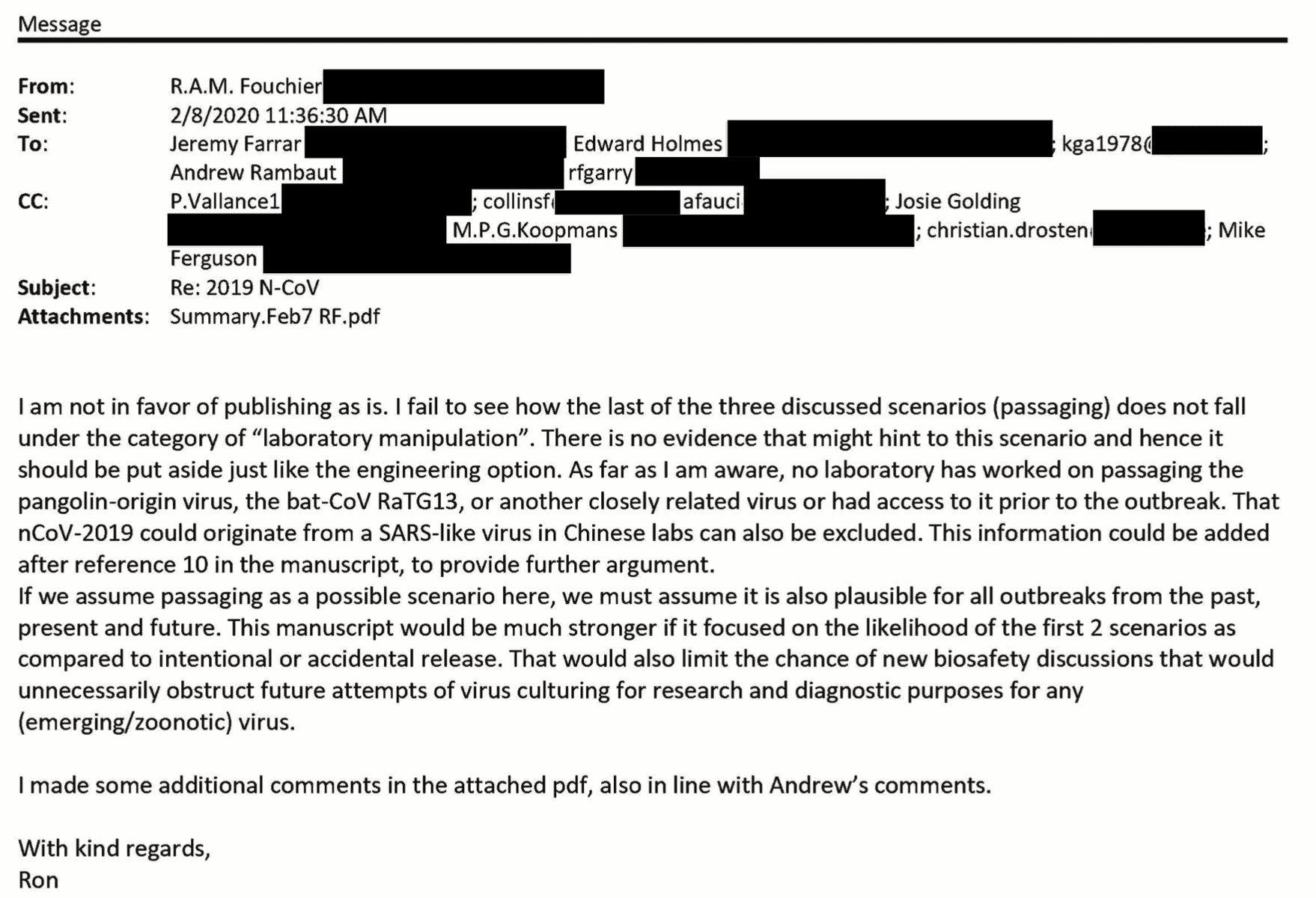
Indeed, Fouchier said he didn’t support publicly addressing the possibility of a lab leak in the “Proximal Origin” paper.
Fouchier said that it could lead to “harm to science” through renewed debates about biosafety.
“This manuscript would be much stronger if it focused on the likelihood of the first two scenarios as compared to intentional or accidental release,” Fouchier said. “That would also limit the chance of new biosafety discussions that would unnecessarily obstruct future attempts of virus culturing for research and diagnostic purposes for any (emerging/zoonotic) virus.”
All content created by the Daily Caller News Foundation, an independent and nonpartisan newswire service, is available without charge to any legitimate news publisher that can provide a large audience. All republished articles must include our logo, our reporter’s byline and their DCNF affiliation. For any questions about our guidelines or partnering with us, please contact [email protected].
Content created by The Daily Caller News Foundation is available without charge to any eligible news publisher that can provide a large audience. For licensing opportunities of our original content, please contact licensing@dailycallernewsfoundation.org