Medal of Honor Monday: Marine Corps Gunnery Sgt. John Basilone
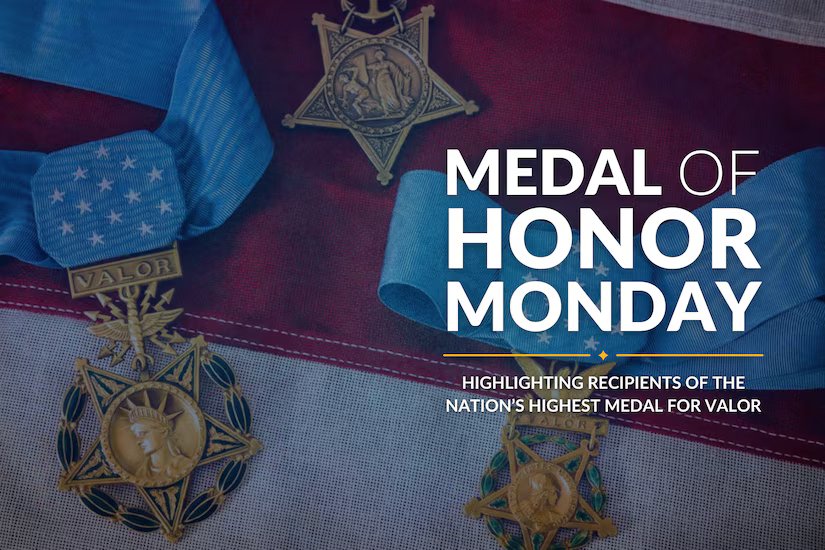
Marine Corps Gunnery Sgt. John Basilone was an infantryman during World War II. He received the Medal of Honor for his actions on Guadalcanal in 1943, and two years later, he posthumously received the Navy Cross for his gallantry during the Battle of Iwo Jima.
Basilone was born Nov. 4, 1916, in Buffalo, New York, and when he was 2, his family moved to Raritan, New Jersey. He was the sixth child born to Salvatore, an Italian immigrant, and Dora; he had nine siblings.
He attended St. Bernard Parochial School in Raritan, but after completing middle school in 1931, he dropped out to work as a golf caddy at the local country club.
In July 1934, Basilone enlisted in the Army and was assigned to the 16th Infantry Regiment at Fort Jay on Governors Island, New York City. However, he wanted to go overseas, so after a few months he accepted a discharge and reenlisted the following day. He joined the 31st Infantry Regiment and immediately deployed to the Philippines, where he served for two years.
While in Manila, Basilone earned a reputation as a formidable amateur boxer, and he acquired the nickname “Manila John.” His time in the Army served him well later in the Marine Corps, where he became an expert marksman.
Upon his honorable Army discharge in 1937, Basilone returned to the U.S. and worked as a truck driver in Reisterstown, Maryland. However, he wanted to return to the Philippines and to military life. So, in July 1940, with war looming, he enlisted in the Marine Corps.
Basilone attended basic training at Marine Corps Recruit Depot, Parris Island, South Carolina, and was deployed to Guantanamo Bay, Cuba, in September 1940.
He was reassigned to the 1st Battalion, 7th Marines, 1st Marine Division, in January 1941, and in September 1942, his unit landed on Guadalcanal in the Solomon Islands.
He was serving as a Marine Corps sergeant in the Lunga area of Guadalcanal Oct. 24, 1942, when about 20,000 Japanese soldiers attacked his unit as they defended Henderson Airfield.
His Medal of Honor citation states that while the enemy was hammering at the Marines’ defensive positions, Basilone, who was in charge of two sections of heavy machine guns, fought valiantly to check the savage assault. In a fierce frontal attack, one of Basilone’s sections, with its gun crews, was put out of action, leaving only two men able to carry out the counterattack.
Moving an extra gun into position, he placed it in action, then, under continual fire, repaired another and personally manned it until replacements arrived. Later, with ammunition critically low, Basilone risked his life and battled his way through hostile lines with shells for his gunners, thereby contributing in large measure to the virtual annihilation of a Japanese regiment.
Marine Corps Maj. Gen. Alexander A. Vandegrift, commanding general of the 1st Marine Division, presented Basilone with the Medal of Honor during a ceremony in Balcombe, Australia, May 21, 1943.
The Marine Corps offered to make him an officer and let him spend the rest of the war in Washington, but he turned them down. Basilone participated in war bond tours in the U.S., but he grew restless again. After repeated denials, the Marine Corps finally approved his request to return overseas in December 1943, but first sent him to Camp Pendleton, California, for training.
He was promoted to gunnery sergeant in March 1944 and formally reenlisted in July. That same month, he married Lena Mae Riggi, a sergeant in the Marine Corps Women’s Reserve.
In August 1944, Basilone returned to the Pacific theater and was assigned to Charlie Company, 1st Battalion, 27th Marine Regiment, 5th Marine Division. In January 1945, his unit sailed for the island of Iwo Jima in the Western Pacific Ocean.
On Feb. 19, 1945, Basilone was killed by a mortar shell during the Battle of Iwo Jima. He posthumously received the Navy Cross for his gallantry.
The citation states that shortly after landing on the island, his company’s advance was held up by the concentrated fire of a heavily fortified Japanese blockhouse. Basilone boldly defied the enemy bombardment and worked his way around the flank and up to a position directly on top of the blockhouse. Then, attacking with grenades and demolitions, he single-handedly destroyed the entire hostile strong point and its defending garrison. Later in the day, he proceeded to the aid of an American tank that was trapped in an enemy minefield. Under intense mortar and artillery barrages, Basilone guided it to safety. Minutes later, he was instantly killed when a Japanese mortar round exploded.
He was 28 years old.
Basilone’s widow accepted the Navy Cross, signed by Secretary of the Navy James Forrestal, during a private ceremony in September 1945.
Basilone is buried at Arlington National Cemetery in Virginia. His wife died June 11, 1999, and was buried in her home state of California.
There’s a bronze statue of Basilone in Raritan, as well as several roads and bridges named for him. In 1981, the city held the first John Basilone Memorial Parade, an annual event held on the third Sunday in September; the route includes Basilone Boulevard, named for him in 2022.
At Camp Pendleton, two highways and a drop zone bear his name.
The destroyer USS Basilone sailed from 1945 to 1977. The guided-missile destroyer USS John Basilone was commissioned Nov. 9, 2024.
In 2005, Basilone was among the four Marines featured in the Postal Service’s “Distinguished Marines” commemorative stamp set.
In 2014, the Basilone Memorial Foundation was established as a nonprofit organization dedicated to supporting military veterans and their families, as well as individuals and families impacted by cancer.
Basilone’s Medal of Honor and Navy Cross are on display at the National Museum of the Marine Corps in Virginia.
This article is part of a weekly series called “Medal of Honor Monday,” in which we highlight one of the more than 3,500 Medal of Honor recipients who have received the U.S. military’s highest medal for valor.
Source: Department of Defense
Content created by Conservative Daily News is available for re-publication without charge under the Creative Commons license. Visit our syndication page for details.