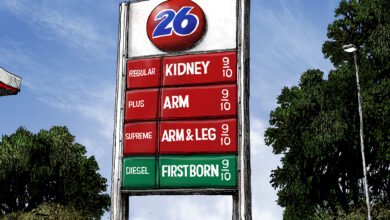
High oil prices due to the Iran conflict are the only thing holding back a roaring economy.

The American economy is currently locked in a fascinating tug-of-war between structural domestic strength and external geopolitical chaos. For months, the fundamental data has pointed toward a roaring supply-side renaissance.
Yet, as American families look at the signs at their local service stations, a lingering question remains: Why are we still paying nearly $3.85 a gallon for gasoline when domestic economic forces say it should be much lower?
Geopolitical Friction Hits the Pump
The answer lies in the volatile crosscurrents of global energy markets; specifically, the high-stakes drama playing out in the Middle East.
Just as the global economy was beginning to breathe a sigh of relief following a diplomatic memorandum of understanding, the fragile U.S.-Iran ceasefire has shattered. The Iranian regime’s repeated, hostile provocations against commercial shipping vessels in the Strait of Hormuz over the last week forced a swift, decisive American military response.
With President Trump declaring the truce officially over and launching massive retaliatory strikes to secure the waterway, energy markets did exactly what they always do when geopolitical instability spikes: they reacted.
West Texas Intermediate (WTI) and Brent crude, which had been on a steady, welcome downward trajectory, immediately reversed course, ticking back up over the $73-to-$75 per barrel range.
Consequently, the steady decline in retail pump prices that gladdened drivers ahead of the Independence Day weekend has hit an abrupt speed bump. The national average, which was on a path to break comfortably below $3.80, notched its first overnight increase in weeks.
This volatility underscores a critical macroeconomic reality: energy is the foundational input for everything we produce, transport, and consume. When energy prices are artificially inflated by foreign fanatics holding global shipping lanes hostage, it acts as a direct, regressive tax on every single American consumer and business.
A Resilient Supply-Side Engine
Yet, despite this geopolitical headwind, the underlying structural health of the U.S. economy remains remarkably resilient. The supply-side engine is firing on all cylinders.
Consider the data: retail sales have shown robust, consecutive monthly increases, proving that the American consumer is still highly engaged. Job creation has defied the skeptics, maintaining a powerful momentum that keeps unemployment low and household balance sheets stable.
Furthermore, Wall Street is signaling deep confidence in the future. The steady rise in equity prices isn’t mere speculation; it is a forward-looking reflection of investors’ firm belief that corporate profits will expand.
This optimism is well-founded. Annual growth in Gross Domestic Product (GDP) is pacing exceptionally well and is on track to reach an impressive 4% by year-end.
The AI Productivity Shield
In any traditional economic cycle, growth of this magnitude would trigger immediate warnings of severe labor shortages and subsequent wage-price inflation. Thankfully, we are witnessing a structural shift that mitigates this risk.
Corporate America is aggressively implementing Artificial Intelligence (AI) and automated technologies. Instead of destroying opportunities, AI is acting as a massive productivity shield.
It serves as a force multiplier, allowing businesses to drastically increase output per worker, control operational costs, and bypass the traditional labor bottlenecks that usually choke off late-stage economic expansions.
Much of this sustainable investment boom is being fueled by smart fiscal policy. Last July’s landmark legislation included a vital, pro-growth provision: the full expensing of capital investments in the year they are made.
By replacing archaic, multi-decade depreciation schedules with immediate tax relief, the code has unlocked a torrent of corporate capital expenditure. Businesses are upgrading infrastructure, buying hardware, and building the future today.
Securing the New Golden Era
This convergence of high growth, potentially sustained at 4% annually, paired with underlying productivity gains means we are on the doorstep of the American economy’s true “Golden Years.”
We are looking at a rare macroeconomic sweet spot: high growth, low unemployment, and low inflation that will likely settle back below 2% once current supply-chain frictions ease.
But to fully unlock this golden era, we must master the energy crosscurrents. The lesson of the broken Iranian ceasefire is simple: global supply chains are too fragile to be left at the mercy of hostile foreign actors.
The only permanent shield against global oil shocks is unadulterated American energy dominance. We have the resources, the technology, and the capital expensing incentives to produce our way to absolute freedom.
By maximizing domestic North American energy output and permanently securing our supply chains, we can insulate our economy from foreign conflicts, push gasoline prices down toward the $3.00 mark, and ensure that the American economic engine stays unshakeable.
Agree/Disagree with the author(s)? Let them know in the comments below and be heard by 10’s of thousands of CDN readers each day!