NYT Gets a Head Start in Advocacy Journalism and Journalistic Malpractice. The Obliterating of the Wall Between News and Editorial Content

The coverage patterns observed in The New York Times reporting on the August 2026 Head Start deregulation follow the exact same strategic blueprint as its SNAP coverage: relying on high-pathos framing, omitting the administration’s stated counter-data, and treating legacy federal programs as an unquestioned moral baseline.
Previously, The CotoBuzz Journal reported on NYT journalistic malpractice regarding its coverage of voter fraud.
When The New York Times dismisses election integrity critiques as “baseless” without examining the underlying system vulnerabilities, it replaces investigative reporting with administrative stenography. By prioritizing official government statements over investigative skepticism, legacy media outlets abandon their core constitutional role as a check on institutional power.
Now, we see this same structural blueprint applied to complex entitlement and education programs. This pattern leverages emotional human-interest vignettes to anchor a policy narrative, shielding the underlying program from rigorous metric-based scrutiny.
The Blueprint: Anatomy of a Narrative Shield
1. Pathos as a Shield Against Structural Scrutiny
• Anecdotal Framing:The New York Times centers personal hardship—such as individuals losing benefits or skipping meals—to frame policy updates exclusively around immediate human suffering.
• Displacing Trade-off Analysis: By focusing heavily on the immediate pain of regulatory shifts, the reporting invites readers to view any policy reduction as systemic cruelty. This emotional framing systematically sidelines critical questions regarding program efficiency, long-term dependency incentives, or structural fraud.
• The Head Start Parallel: In the Head Start coverage, the paper anchors its narrative with emotional descriptions of “the most impoverished young children in the U.S.” being harmed. By using aggressive, unverified phrasing like a “push to gut the program” in the straight news text, the reporting invites readers to view a regulatory rewrite through an exclusively emotional lens of destruction, rather than a structural optimization lens.
2. Omission of Contradictory Macro Data
• Health Outcomes vs. Intentions: While SNAP is framed as an essential nutrition lifeline, media reports rarely reconcile this intent with broader health data. Raw USDA data consistently reveals higher descriptive obesity rates among SNAP participants compared to income-eligible non-participants, raising unexamined questions about the program’s actual nutritional footprint.
• Spending Discrepancies: Legacy reporting rarely interrogates point-of-sale data showing that the program routinely finances luxury items or low-nutrition products (like soft drinks) due to a near-total lack of strict federal purchasing restrictions.
• The Head Start Parallel: The Head Start coverage similarly minimizes or omits the administration’s explicit, measurable goals for the Notice of Proposed Rulemaking (NPRM). The proposal aims to dramatically reduce a 133-page federal playbook down to a lean framework, slashing administrative overhead from 15% to 5%. HHS explicitly projects $2.2 billion in bureaucratic savings to expand access and fund up to 236,000 more child slots. By focusing primarily on “deregulation” as an inherent negative, the reporting suppresses the administrative argument that stripping federal mandates is intended to achieve scale and increase local flexibility.
3. Conflating Timeline Context to Preserve the Narrative
• The SNAP Parallel: Legitimate human anxiety over 2025–2026 reforms is bundled together to create a single, continuous story of an adversarial system attacking the vulnerable.
• The Head Start Parallel: The reporting pulls earlier quotes and pushback from figures like Governor Pritzker—which were originally directed at actual 2025 funding freezes, draft budget disruptions, and program closures—and grafts them onto the August 2026 regulatory overhaul. Treating a structural performance rewrite and a total budget freeze as interchangeable “attacks” ignores the fundamental shift in strategy, serving a pre-existing editorial narrative (“the administration is trying to destroy early education”) instead of accurately describing the new rule on the table.
4. Administrative Stenography vs. Selective Skepticism
• Selective Institutional Trust:The New York Times exhibits a double standard in its journalistic skepticism. On issues like election integrity, it acts as a stenographer for institutional authorities by automatically labeling outsider critiques as “baseless.”
• Insulating the Status Quo: Conversely, when evaluating sweeping federal transfer programs like SNAP or Head Start, the paper treats the massive existing infrastructure as an unquestioned moral good. The paper operates as an administrative stenographer for early childhood advocacy groups, treating their warnings of “dismantled safeguards” as objective facts, while treating the administration’s stated goals of federalism and parent empowerment as mere political cover.
Byline Tracking: The National Desk & The Washington Bureau
Policy shifts impacting domestic welfare are handled by teams tracking the intersection of federal authority and local impact. The specific desks driving this framing are the National Desk and the Washington Bureau.
• Coral Davenport (Washington Bureau/Politics): Author of the August 6, 2026, breaking news feature explicitly titled “Trump Administration to Deregulate Head Start”. Her framing centers strongly on the warning that “advocates fear the anti-poverty program will be gutted”, using high-pathos language directly alongside the technical details of the 133-page rollback.
• Jason DeParle: While Davenport handles the immediate Washington policy mechanics, DeParle frequently steps in to provide the broader, narrative-driven pieces that lean heavily into human-interest vignettes to reinforce the legacy framework.
Infographic: The “Pathos vs. Metrics” Divide
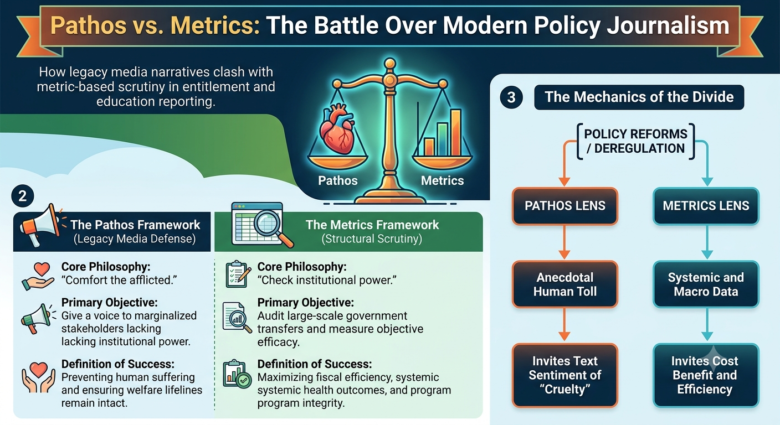
• Pathos (Legacy Media): Focuses on personal hardship, fostering emotional responses.
• Metrics (Critical Analysis): Focuses on macro-level data, program efficiency, and trade-offs.
• Result: Favoring exclusive emotional storytelling over data crosses into advocacy journalism.
The Anatomy of a Narrative Shield
• Pathos Over Policy: The NYT anchors its coverage of the August 2026 Head Start deregulation on personal, emotional stories of potential benefit loss, painting regulatory changes as destructive rather than as structural optimizations.
• Omitting Macro Data: Reports rarely address contradictions, such as USDA data showing higher obesity rates among SNAP participants or the lack of strict nutritional controls. Similarly, the Head Start coverage overlooks the administration’s stated goals of reducing 133 pages of bureaucracy, saving $2.2 billion, and increasing enrollment by 236,000.
• Contextual Merging: The reporting often merges current regulatory updates with past, unrelated budgetary conflicts to maintain a consistent narrative of administrative failure.
• Selective Skepticism: While aggressively challenging the administration, the newspaper acts as an unquestioning stenographer for advocacy groups, treating their perspectives as objective facts.
Case Studies in Narrative Selection
This section provides real-world examples of how this divide manifests in specific policy coverage.
Case 1: SNAP (Food Stamps)
• Pathos Focus: Front-page stories tracking single mothers or cancer survivors skipping meals due to tighter eligibility rules.
• Sidelined Metrics: USDA point-of-sale data showing millions spent on luxury items; raw data showing elevated participant obesity rates.
Case 2: Head Start Deregulation
• Pathos Focus: Headlines warning that the anti-poverty program is being “gutted,” relying on predictions from advocacy groups.
• Sidelined Metrics: HHS projections of $2.2 billion in bureaucratic savings and 236,000 newly funded child slots from cutting red tape.
Section 5: The Cost of Imbalance
A horizontal warning callout box at the bottom of the infographic.
• The Takeaway: When journalism favors exclusive emotional storytelling over systemic data, it crosses from objective reporting into advocacy journalism.
• The Result: The public is left with feeling rather than facts, shielding massive legacy institutions from the rigorous scrutiny required for democratic accountability.
The Case for Pathos-Driven Reporting
Advocacy journalism proponents argue that human-interest framing is necessary to give voice to the vulnerable, translate complex legislation, and prioritize human well-being over fiscal efficiency.
Byline Tracking: The National Desk
Key reporting stems from the Washington Bureau, notably Coral Davenport, who framed the Head Start deregulation as a “gutting” of the program, and Jason DeParle, who often reinforces the narrative using personal vignettes.
Conclusion: Advocacy Over Reporting
The evidence indicates a shift from objective reporting to advocacy, where emotional narratives replace balanced analysis. This leaves the public with emotional narratives instead of the data necessary to evaluate the efficacy of these major social programs.
NYT/Media Modus Operandi
The evidence demonstrates how a media outlet can cross from objective news coverage into advocacy journalism. By selectively elevating emotional human-interest narratives while minimizing conflicting macro-level data, the reporting systematically steers the audience toward a pre-determined political conclusion rather than providing a balanced assessment of policy trade-offs.
Agree/Disagree with the author(s)? Let them know in the comments below and be heard by 10’s of thousands of CDN readers each day!